
Views: 0 Author: Site Editor Publish Time: 2026-09-30 Origin: Site


Did you know material handling delays cost construction sites thousands of dollars daily? Picking the wrong lifting equipment does more than just risk severe safety hazards. It actively causes expensive operational downtime and project bottlenecks that can derail an entire quarter's budget.
Recent market intelligence and industry trends highlight a massive shift toward ergonomic safety and precision handling in modern industrial environments. Analysts note that as workplace safety regulations tighten globally, facility managers are rapidly moving away from manual labor. Instead, they are investing heavily in automated, reliable vertical lifting solutions equipped with advanced overload protections and higher duty cycles. This evolution is directly driven by the need to minimize liability and maximize throughput in high-demand sectors. As supply chains tighten and production quotas increase, relying on outdated or underspecified hoisting gear is no longer a viable business strategy. In this comprehensive guide, you will learn exactly how to navigate these technical requirements and choose the right lifting equipment for your specific operational needs.
Capacity is King: Always choose lifting equipment with a Safe Working Load that strictly exceeds your heaviest anticipated load.
Speed and Height Matter: Match your hoisting speed and maximum lift height to your daily production pace and facility dimensions.
Power Supply Dictates Performance: Ensure your site's voltage infrastructure aligns precisely with the motor requirements to avoid catastrophic electrical failure.
Safety First: Never compromise on built-in safety mechanisms like upper and lower limit switches, overload slip clutches, and dual braking systems.
Environment Impacts Lifespan: Consider weatherproofing and duty cycles based on whether the equipment operates indoors, outdoors, or in harsh environments.
The Safe Working Load, frequently referred to as the Working Load Limit, is the absolute maximum mass a lifting device is engineered to safely suspend, lift, or lower. It serves as the foundational metric in your decision-making process. Selecting a unit with an inadequate capacity not only violates strict industrial safety regulations but also introduces severe risks of mechanical failure, dropped loads, and catastrophic workplace accidents.
Determining your required capacity involves much more than simply checking the shipping weight of the primary object you intend to lift. A remarkably common engineering mistake on job sites is failing to account for below-the-hook accessories. To calculate the true load weight, you must aggregate the mass of the item itself along with all associated rigging hardware.
Load Component | Description | Example Weight |
|---|---|---|
Primary Payload | The actual material, machinery, or structural component being lifted. | 350 kg |
Rigging Hardware | Slings, chains, shackles, or eye bolts used to secure the payload. | 15 kg |
Spreader Beams | Structural beams used to distribute the weight of wide or awkward loads. | 35 kg |
Total Lift Weight | The combined mass that the hoist motor must actually pull. | 400 kg |
Industrial lifting standards strongly recommend implementing a capacity buffer zone. As a general engineering best practice, you should select an equipment capacity that is 20 to 25 percent higher than your maximum calculated load weight.
For instance, if your total calculated lift weight regularly reaches 400kg, you should avoid purchasing a unit rated exactly for that limit. Instead, opting for a 500kg Electric Chain Hoist prevents the motor from operating at its absolute maximum limit day in and day out. This strategic buffer drastically reduces thermal strain on internal components, minimizes gear wear, and significantly extends the operational lifespan of your investment.
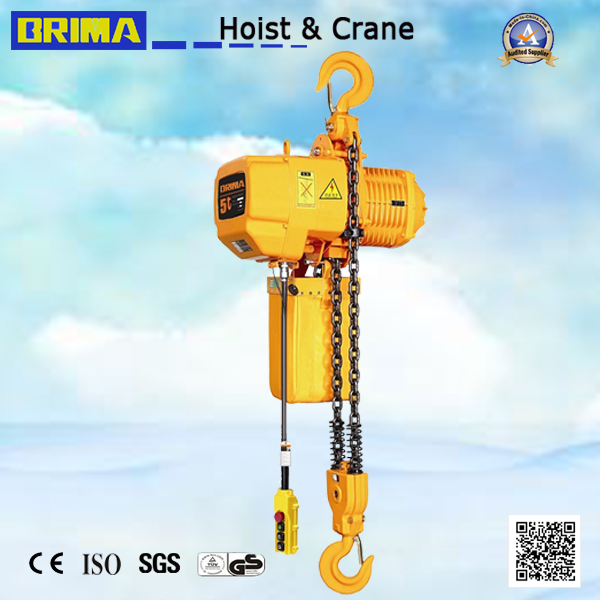
Lift height is not simply the raw measurement from your concrete floor to the ceiling rafters. Specifically, it is defined as the exact vertical distance from the hoist's suspension point down to the lowest possible point the bottom hook needs to reach during active operation.
When specifying this dimension, you must simultaneously account for the chain container. This bag must be adequately sized to hold the entire length of the slack chain when the hook is in its highest position. Picture a scenario where an undersized chain container is used on a busy site. The excess chain spills over the side, immediately creating a severe jamming hazard that can shear the internal load sprocket.
The speed at which your load moves vertically directly impacts both operational efficiency and material safety. Single-speed motors operate at a constant, aggressive velocity. They are highly efficient for standard, repetitive lifting tasks where rapid transfer is required and pinpoint precision is not the primary concern.
In contrast, dual-speed models utilize a specialized motor offering two distinct operational speeds. A standard speed handles the general lifting, while a micro-speed allows operators to slowly and precisely position fragile loads. If you are aligning heavy machinery or carefully placing glass panes on a construction site, this micro-speed functionality prevents sudden jerking motions that could shatter the payload.
Beyond mechanical specifications, the electrical infrastructure of your facility or job site will ultimately dictate the type of motor you can deploy. Single-phase power is standard in residential garages, light commercial workshops, and temporary early-stage construction sites. While convenient, single-phase motors are generally restricted to lighter duty cycles and lower overall capacities.
Furthermore, heavy-duty industrial manufacturing plants rely almost exclusively on three-phase power. Because they draw less electrical current per phase, three-phase motors deliver continuous and consistent torque. This results in lower operating temperatures, making them inherently more durable for relentless, continuous applications.
It is an absolute necessity to verify your site's voltage, phase, and hertz prior to procurement. Connecting a heavy-duty lifting device to an incompatible or fluctuating power source will instantaneously fry the motor windings and weld the electrical contactors shut. Always consult with a certified site electrician to confirm the available power supply at the exact structural beam where the equipment will be installed.
A top hook suspension remains the most straightforward and widely utilized mounting method in the industry. The unit is simply suspended from a fixed anchor point, a structural beam clamp, or an existing manual trolley via a heavy-duty forged top hook. This configuration provides exceptional portability and rapid deployment. For example, deploying a rugged construction electric chain hoist utilizing a top hook design offers immense stability for localized material handling, allowing crews to set up and tear down quickly on dynamic job sites.
When lateral movement along an I-beam or H-beam is required, a trolley system becomes mandatory. A manual trolley requires the floor operator to physically push the suspended load along the runway beam. From a practical standpoint, this manual method is generally recommended only for lower capacities typically under 2 tons and niche applications where lateral movement is infrequent.
For heavy loads, high-frequency lateral movements, or expansive warehouse runway distances, a motorized trolley is the optimal engineering choice. Powered by an integrated electric motor, these trolleys glide the load along the beam seamlessly at the push of a button on the pendant control. Consequently, motorized trolleys drastically reduce operator fatigue, eliminate the severe ergonomic risks associated with physically shoving heavy steel, and provide smooth acceleration.
Mechanical specifications and lifting capacities are only one piece of the puzzle. Industry analysts consistently note that the physical environment in which the equipment operates, combined with the frequency of its use, ultimately dictates long-term reliability. A unit perfectly designed for a clean automotive assembly line will choke and fail within weeks on a dusty, rain-swept construction site if not properly specified.
Duty cycle defines exactly how long a motorized lifting device can operate continuously within a specific timeframe without the internal insulation degrading from heat. When electrical current passes through a motor, it generates significant thermal energy. If the motor is not given adequate downtime to dissipate this heat, catastrophic failure is imminent.
Industry standards established by the Hoist Manufacturers Institute and the European Federation of Materials Handling categorize equipment into specific duty classes. Selecting the correct classification ensures the motor's thermal capacity aligns with your real-world operational tempo.
HMI Class | FEM Class | Max On-Time per Hour | Typical Application Scenarios |
|---|---|---|---|
H2 | 1Bm | 9 minutes | Light machine shop maintenance, infrequent lifting. |
H3 | 1Am | 15 minutes | General assembly, moderate warehouse operations. |
H4 | 2m | 30 minutes | Heavy manufacturing, continuous construction material handling. |
For intensive applications where materials are constantly being moved, specifying a heavy-duty cycle is highly recommended. This robust rating ensures the equipment withstands rigorous demands without triggering thermal overload sensors and halting your production line.
The physical operating environment directly impacts the required Ingress Protection rating. Standard units are typically designed for clean, dry, indoor environments. However, if your operations take place outdoors or in harsh industrial settings, you must upgrade your specifications.
For outdoor construction sites exposed to driving rain, or industrial facilities with high airborne particulate matter, a higher IP rating is absolutely mandatory. Sub-zero conditions demand specialized lubricants and internal condensation heaters to prevent the mechanical brake pads from freezing solid. By investing in a properly sealed electric chain hoist, you ensure that unpredictable environmental factors never compromise your operational efficiency.
In modern material handling, occupational safety is the absolute highest priority. Trend reports indicate that regulatory bodies are increasingly cracking down on worksite safety, demanding redundant fail-safes on all lifting apparatus. The inherent risks associated with vertical lifting necessitate the inclusion of robust, uncompromising safety mechanisms.
Overloading remains one of the most common causes of equipment failure and fatal workplace accidents. An overload protection system, most commonly engineered as a mechanical slip clutch, acts as your primary physical defense against lifting loads that exceed the rated capacity.
Integrated directly into the gear train, this friction mechanism is factory-calibrated to physically slip when the applied torque exceeds a predetermined threshold. If a worker attempts to rip a concrete form out of the ground that is too heavy, the clutch slips. The motor continues to hum, but no rotational force is transferred to the lifting chain. This brilliant mechanism prevents the chain from snapping under tension and protects the structural integrity of the building's support beams.
Limit switches are vital electromechanical safety sensors designed to prevent the load block from over-traveling. If an operator is distracted and inadvertently holds the up button for too long, the heavy load block could violently crash into the hoist body. This dangerous scenario can shatter the aluminum housing and cause the payload to plummet.
To combat this, an upper limit switch automatically severs electrical power to the hoisting contactor the split second the load block reaches its maximum safe upward position. Similarly, a lower limit switch prevents the chain from running completely out of the unit, guaranteeing a safe minimum number of chain links remain securely engaged with the internal load sprocket.
The braking system bears the immense responsibility of holding the load securely in mid-air when the motor is not actively running. For maximum safety compliance, high-quality units employ a fail-safe electromagnetic disc brake architecture.
This system relies on heavy-duty spring pressure to clamp the brake pads against the motor shaft at all times. When the operator presses a button on the pendant, electrical current energizes a magnetic coil, pulling the pressure plate back and releasing the brake. If a sudden power outage plunges the facility into darkness, the magnetic field dissipates instantly. The mechanical springs automatically re-engage the brake in milliseconds, freezing the load securely in place without any human intervention.
Procurement decisions in the industrial sector should never be based solely on the lowest initial sticker price. The Total Cost of Ownership comprehensively encompasses upfront costs, routine maintenance labor, spare parts pricing, and potential downtime. This provides a much more accurate financial metric for facility managers.
Routine maintenance is unavoidable for any mechanical equipment subjected to heavy daily loads. The load chain requires regular lubrication with extreme-pressure gear oil to minimize friction on the load sheave, while the braking mechanism requires periodic gap adjustments as the friction pads naturally wear down.
When evaluating different manufacturers, closely analyze the equipment's physical architecture. Modular designs that allow maintenance personnel to quickly open the electrical panel, adjust the brake coil, or swap the chain container without dropping the entire unit to the floor will save countless hours of expensive labor. Verify the availability of replacement parts to avoid weeks of agonizing operational downtime.
The temptation to minimize capital expenditure by purchasing budget-tier lifting equipment invariably leads to inflated long-term costs. Low-cost units frequently utilize inferior motor insulation, plastic internal gears, and low-grade chain steel. These dangerous compromises lead to frequent breakdowns, premature motor burnout, and unacceptable safety risks.
Savvy operators calculate the Return on Investment by factoring in the true cost of operational downtime. If a cheap unit fails on a critical job site, the resulting halt in productivity can cost thousands of dollars per day in idle labor and delayed project timelines. Investing in a highly durable, precisely engineered unit like the Brima 500kg Construction Hoist ensures consistent daily performance. Premium equipment drastically reduces maintenance intervals and ultimately yields a significantly lower Total Cost of Ownership over a demanding lifespan.
The primary difference lies in the lifting medium and the internal mechanics. A chain hoist utilizes a specialized sprocket to pull a calibrated steel link chain. This design is highly compact, provides a true vertical lift with minimal lateral drift, and is ideal for capacities under 10 tons. Conversely, a wire rope hoist uses a grooved cylindrical drum to wind a multi-strand steel cable. Wire rope units are physically larger, much heavier, and are generally preferred for extremely high-capacity lifts over 10 tons or applications requiring exceptionally fast lifting speeds and massive lift heights.
Capacity selection must be based on the absolute maximum weight you intend to lift, plus a strict safety buffer. First, accurately calculate the weight of your heaviest payload. Next, add the weight of all below-the-hook rigging equipment, such as spreader beams, slings, and custom shackles. Finally, apply the 25 percent buffer rule. If your total calculated weight is 400kg, you should round up and select a 500kg capacity unit. This prevents the motor from operating at its absolute maximum limit, thereby reducing mechanical strain and extending the equipment's lifespan.
Yes, they can be utilized outdoors, provided they are specifically configured for environmental exposure. The unit must have a high Ingress Protection rating to safeguard the internal electrical contactors and motor windings from rain and airborne dust. Additionally, outdoor units should be equipped with weather covers or parked beneath a structural canopy when not in active use. In regions with high humidity or fluctuating temperatures, internal space heaters should be factory-installed to prevent condensation from forming on the sensitive brake discs.
A duty cycle is a standardized engineering metric that defines exactly how long a hoist can operate continuously within a one-hour period without the motor overheating. It is expressed in maximum minutes of operation per hour and the maximum number of motor starts per hour. Exceeding the duty cycle will cause the motor's internal thermal protection switches to trip, temporarily disabling the unit until it safely cools down.
Inspection frequencies are strictly dictated by safety standards and depend heavily on the severity of use. Operators must perform a basic visual inspection before every single shift, checking for adequate chain lubrication, hook deformation, and proper pendant function. Frequent inspections should be conducted monthly or quarterly by in-house maintenance staff to check brake wear and limit switch operation. Periodic inspections require a certified technician annually or semi-annually to perform a comprehensive teardown and precise micrometer measurement of chain link wear.
Neither is objectively better; the choice depends entirely on your facility's electrical infrastructure and operational demands. Three-phase motors are highly efficient, draw less amperage, run significantly cooler, and are the undisputed standard for heavy-duty industrial and continuous construction applications. Single-phase motors, while generally limited to lower capacities and lighter duty cycles, are highly convenient for temporary job sites where industrial three-phase power has not yet been routed.
High-quality motorized lifting equipment is specifically designed with fail-safe braking mechanisms to prevent catastrophic accidents during unexpected power failures. The system utilizes a normally closed, spring-applied magnetic brake. During normal operation, electrical current holds the brake open. If the facility loses power, or if the main power cord is severed, the electromagnetic field instantly collapses. Heavy-duty mechanical springs immediately force the brake pads against the motor shaft, securely freezing and holding the suspended load in mid-air until power is safely restored.
Choosing the right lifting equipment requires careful, methodical planning rather than a rushed purchase based on price alone. You must rigorously evaluate your required capacity, hoisting speed, and available electrical power supply to ensure operational compatibility on your site.
Furthermore, recognizing how environmental factors and duty cycles affect internal components is crucial for long-term reliability. By prioritizing non-negotiable safety features like slip clutches and fail-safe brakes, a properly specified hoist ensures a significantly safer workplace environment while making your daily material handling operations highly efficient.
Always invest in reliable, proven lifting solutions rather than cutting corners. If you are looking to maximize your project's success and safeguard your crew, take the time to explore high-quality equipment tailored specifically to your heavy-lifting demands. Evaluate your site requirements today and select a robust lifting solution that guarantees safety and performance for years to come.
