
Views: 0 Author: Site Editor Publish Time: 2026-09-30 Origin: Site


Are heavy loads bottlenecking your daily site operations? Picture a bustling manufacturing floor or a demanding construction site. Materials demand constant repositioning. In these high-stakes environments, picking the wrong lifting equipment introduces severe safety hazards and causes costly downtime.
Navigating the technical specifications of overhead lifting gear can feel overwhelming. Understanding exactly how to select the perfect motorized lifting solution will transform your workflow. This comprehensive guide evaluates capacity, speed, mobility, and safety mechanisms to help you find the exact match for your facility.
Capacity is King: Always choose a hoist with a Safe Working Load that exceeds your heaviest expected load. Opting for a 1-ton capacity model when handling 1,500-pound loads ensures long-term structural integrity.
Speed Matters: Double-speed models offer a highly efficient mix of fast lifting for general movement and precise, slow positioning for delicate material placement.
Mobility: Pairing your hoist with a motorized trolley allows for seamless horizontal movement across your jobsite. This significantly reduces manual labor and prevents ergonomic injuries.
Power and Duty Cycle: Matching the equipment voltage and duty cycle to your facility power supply prevents premature motor burnout.
Safety First: Overload clutches, limit switches, and electromagnetic brakes are non-negotiable features for maintaining strict jobsite safety standards.
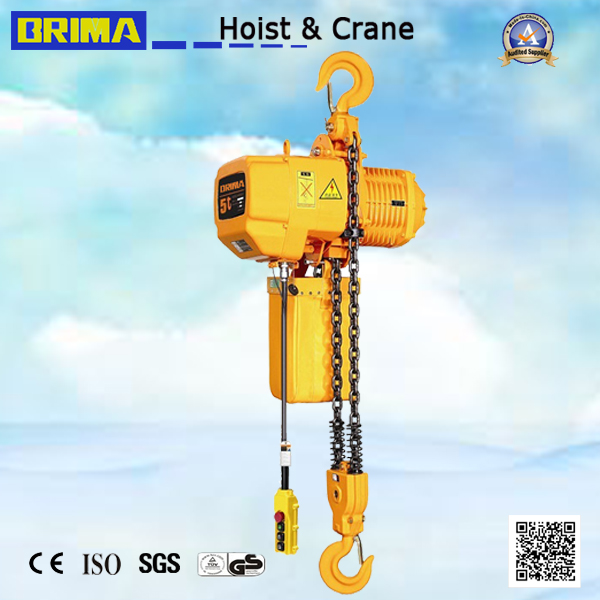
At its core, an Electric Chain Hoist is a robust motorized lifting device designed to raise and lower materials using a durable metal chain and a load hook. Inside the rigid exterior housing, an electric motor drives a series of precision gears. These gears turn a chain sprocket. Ultimately, this mechanism lifts the suspended load vertically with consistent, controlled power.
Manual chain blocks rely entirely on human physical force. Motorized versions utilize electricity to do the heavy lifting. This fundamental shift provides substantial operational benefits. Specifically, it drastically cuts down the time spent on repetitive lifting tasks. It minimizes operator fatigue. Furthermore, it dramatically lowers the risk of musculoskeletal injuries among your crew.
These devices serve as the backbone in various industrial environments. Common applications range from manufacturing plants where raw materials need constant feeding into CNC machines, to warehouses handling awkwardly shaped heavy pallets. By integrating this specialized equipment into your daily workflow, you establish a safer, more predictable, and highly efficient material handling ecosystem.
The Safe Working Load, frequently referred to as the Rated Capacity, represents the absolute maximum weight the equipment is engineered to lift safely. Manufacturers determine this strict limit through rigorous stress testing. Exceeding this limit is never an option. Doing so compromises the internal gearing and stretches the load chain beyond its yield point. This creates a severe hazard that could lead to catastrophic equipment failure.
To accurately gauge your jobsite requirements, calculating the maximum weight of the items you plan to lift is just the starting point. You must also factor in the dead weight of all below-the-hook rigging equipment. This includes lifting slings, steel shackles, spreader bars, and any custom lifting fixtures attached to the hook.
Consider this practical calculation example from an engineering perspective. Your maximum item weight is 1,400 pounds. Your rigging equipment weighs 100 pounds. Your total load equals 1,500 pounds.
Industry best practices strongly recommend rounding up to the next standard capacity tier to create a reliable safety buffer. If your total calculated load is 1,500 pounds, selecting a 1-ton capacity unit is the smartest, most durable choice. This proactive approach prevents the motor from constantly running at its absolute limit. Consequently, it significantly extends the lifespan of the internal components.
Lift height, often referred to in the industry as reach, is the exact vertical distance the load hook can travel. To calculate your required lift height, measure the distance from the hoist resting position straight down to the lowest point the hook needs to reach to engage the load. The resting position is typically the bottom flange of the overhead I-beam. Taking accurate measurements upfront ensures you do not purchase a chain that falls short. A short chain renders the equipment useless for floor-level pickups.
When a heavy load is hoisted into the air, the slack chain must be safely managed. Chain containers, sometimes called chain bags, are essential accessories. They catch and neatly store the excess chain, preventing it from tangling or dangerously interfering with the load below.
In addition, facility managers must account for headroom. Headroom is the vertical distance between the suspension point on the beam and the inner bowl of the load hook when it is fully retracted. In workshops or garages with low ceilings, standard models may not provide enough clearance to lift bulky items over obstacles. In these constrained scenarios, specialized low-headroom models become necessary to maximize every inch of available vertical lifting space.
Single-speed models operate at one constant lifting and lowering velocity. These units are straightforward and generally more cost-effective. They are also easier to maintain due to simpler electrical contactors. They are best suited for basic, repetitive lifting operations where raw speed is required, but precise millimeter-level placement is not the primary concern. Typical examples include basic loading dock operations or rapidly moving bulk materials into large hoppers.
In contrast, a double-speed motor provides operators with two distinct operational velocities. It features a rapid main speed and a slow creep speed. This dual functionality is typically achieved through a dual-winding motor or a sophisticated Variable Frequency Drive.
The fast speed is utilized to move materials quickly across large vertical distances, optimizing overall jobsite efficiency. Conversely, the slow speed is engaged exactly when the load approaches its final destination. This allows for delicate, highly precise positioning without sudden jerks or dangerous load swinging. For operations requiring maximum control, high-quality double speed electric chain hoists are highly recommended. They are perfect for aligning heavy machinery parts, setting glass panels, or lowering engines into vehicle bays.
Beyond vertical lifting, the suspension type determines how the unit is mounted and whether it can travel horizontally along a structural steel beam.
A top hook suspension represents the simplest mounting configuration. The unit is hung directly from a fixed anchor point or an existing manual trolley using a rigid top hook. This setup is strictly designed for vertical lifting. It is ideal for stationary assembly workstations where materials are brought directly to the hook, rather than the machine moving across the shop floor to retrieve the materials.
For basic horizontal mobility, a manual push trolley is mounted to an overhead I-beam. The operator manually pushes or pulls the suspended load to move it along the beam path. While cost-effective, this is only suitable for lighter loads specifically under half a ton. It is also limited to shorter travel distances where physical exertion remains well within safe ergonomic limits.
When dealing with heavy industrial loads, manual pushing quickly becomes hazardous and highly inefficient. Integrating your lifting system with a motorized trolley is the optimal engineering solution. An electric chain hoist with an electric trolley allows the operator to control both vertical lifting and horizontal travel directly from a single low-voltage pendant controller.
This motorized setup completely eliminates the physical strain of pushing heavy items. It significantly reduces the risk of workplace slip-and-fall injuries or muscle strains. It is particularly crucial for capacities of one ton or more, ensuring seamless, controlled movement across the entire span of the facility.
Configuration Type | Speed Control | Horizontal Mobility | Best Application Scenario |
|---|---|---|---|
Basic Top Hook | Single Speed | None - Stationary | Fixed assembly stations, basic vertical lifting. |
Manual Push Trolley | Single Speed | Manual Push/Pull | Light loads under 1,000 lbs, short travel distances. |
Electric Trolley Double Speed | Fast & Slow Creep | Fully Motorized | Heavy industrial manufacturing, precise mold setting, long beam spans. |
Before finalizing any purchase, you must verify your facility electrical infrastructure to avoid costly incompatibility issues.
Three-phase power, such as 220V, 380V, or 440V, is the gold standard for industrial environments. Three-phase motors are inherently more efficient and run cooler under stress. They are specifically designed for continuous, heavy-duty use. On the other hand, single-phase power like 110V or 220V is common in residential garages, small workshops, or temporary construction sites. While convenient for plug-and-play setups, single-phase motors draw more electrical current and tend to heat up faster during prolonged heavy lifting.
The duty cycle dictates exactly how long the motor can operate within a given timeframe before it must be allowed to cool down. Ignoring this metric is the fastest way to cause motor burnout and incur expensive repair bills.
The American Society of Mechanical Engineers classifies duty cycles to help buyers perfectly match equipment to their operational tempo. For instance, H2 Light Duty is suitable for infrequent lifting where the machine sits idle for long periods. H3 Medium Duty is ideal for general machine shop fabrication. Finally, H4 Heavy Duty is engineered for high-volume handling in steel warehouses or fast-paced manufacturing lines. Always evaluate your daily shift hours to select a classification that prevents thermal overload.
When dealing with overhead material handling, safety is never an optional upgrade. It is a strict regulatory requirement. Equipment failure can lead to severe property damage, operational downtime, or fatal injuries. Therefore, selecting a model equipped with comprehensive fail-safe mechanisms is critical for compliance with occupational safety standards like those set by OSHA.
One of the most common causes of crane accidents is attempting to lift a load that exceeds the Safe Working Load. To mitigate this risk, high-quality models feature a mechanical overload protection system known as a slip clutch. Factory-calibrated to engage when a load reaches approximately 110 to 125 percent of the rated capacity, the clutch will slip if an overload occurs. This allows the motor to continue running without transferring torque to the lifting sprocket, preventing structural damage and keeping the chain from snapping.
Over-travel is another significant hazard. If a hook is raised too high, it can crash into the main body. This dangerous situation is known as two-blocking. Conversely, lowering the chain too far can cause it to run entirely out of the housing. Electromechanical limit switches act as physical boundaries. When the load block reaches the maximum safe height, it triggers the upper switch. This immediately interrupts the control circuit and stops the motor.
Reliable load suspension depends entirely on the braking architecture. Compliant industrial models utilize a dual-braking system for ultimate redundancy. The primary electromagnetic motor brake is fail-safe. If the facility loses power or the operator releases the button, heavy-duty springs instantly engage the brake pads to halt the load. Acting as a secondary backup, a mechanical load brake uses the weight of the load itself to generate friction. This ensures the load does not drop even if the primary brake experiences excessive wear.
The material handling sector is rapidly evolving, driven by a need for higher efficiency and stricter workplace safety standards. Recent industry analyses highlight a significant shift toward smart lifting technologies. The integration of Variable Frequency Drives is becoming the new baseline. These drives allow for infinitely variable speed control, reducing load sway and extending the lifespan of brake components by providing smoother acceleration and deceleration.
Furthermore, there is a massive industry push toward ergonomic safety. Facility managers are increasingly moving away from manual push trolleys in favor of fully motorized horizontal travel systems. This transition is heavily influenced by rising workers compensation claims related to manual material handling. By adopting equipment that can be operated via wireless radio remote controls, operators can maintain a safe distance from suspended loads. This drastically improves jobsite visibility and reduces the risk of crushing injuries. Investing in modernized, automated lifting gear is no longer just about lifting heavier weights. It is about creating a smarter, safer, and more resilient operational workflow.
Navigating the technical specifications of lifting equipment can be complex. However, applying a systematic engineering approach ensures you select a unit that maximizes operational efficiency and safety. The ideal setup must align precisely with your facility power supply, meet your maximum load requirements, provide necessary horizontal mobility, and include all standard safety mechanisms.
For operations requiring a robust, versatile, and highly controlled lifting solution, investing in a comprehensively equipped unit is the most cost-effective strategy. Based on the criteria outlined in this guide, a standout configuration is the Brima 1-ton Electric Chain Hoist with Electric Trolley Double Speed. This specific class of equipment effectively addresses the most demanding material handling challenges on modern jobsites.
Here is an objective breakdown of why this specific configuration meets stringent industrial buying criteria:
Optimal 1-Ton Capacity: A 2,000-pound Safe Working Load provides a substantial safety margin for most medium-duty industrial applications. It prevents equipment strain while avoiding the unnecessary bulk of massive 5-ton units.
Precision Control: The double-speed functionality fundamentally changes how operators handle fragile materials. The fast speed allows for rapid vertical transport. The slow creep speed allows the operator to gently position a machined part onto a workbench without damaging the load.
Seamless Mobility: The integrated electric trolley completely eliminates the physical strain associated with manual push trolleys. It allows seamless movement along I-beams via a single pendant controller.
Robust Safety: Engineered with rigorous safety standards, it includes essential features like reliable electromagnetic braking, overload slip clutches, and limit switches to protect both the operator and the load.
When you integrate high-quality motorized lifting equipment into your workflow, you are not merely purchasing a tool. You are investing in a system that reduces liability, protects your workforce, and directly improves daily throughput.
Choosing the right lifting equipment requires careful planning and a deep understanding of your jobsite demands. You must rigorously evaluate capacity, lift height, speed requirements, and built-in safety features before making a decision.
A properly configured system protects your workers every single day. It eliminates the ergonomic hazards of manual lifting, improves overall workflow, and significantly boosts jobsite efficiency. Review your daily operational needs and consider future growth. Assess your facility requirements today and upgrade your material handling processes for a safer, more productive tomorrow. For reliable, industrial-grade lifting solutions tailored to your specific project needs, explore the full range of professional equipment at Brima Hoist.
Standard models are primarily designed for indoor industrial environments. However, they can be used outdoors if specific precautions are taken. You must check the equipment Ingress Protection rating. An IP54 or IP55 rating means the unit is protected against dust ingress and low-pressure water jets, making it somewhat weather-resistant. For permanent outdoor installations, you must install a customized weather cover over the unit to protect the motor, electrical panels, and braking systems from direct rain, snow, and UV degradation. Additionally, outdoor equipment requires more frequent lubrication to prevent the load chain from rusting due to condensation and humidity.
Both are motorized lifting devices, but they serve different operational needs based on their mechanical design. Chain-based models use a calibrated steel link chain and a lifting sprocket. They pull the load in a true, straight vertical line without lateral drift. They are generally more compact, lighter, easier to maintain, and highly cost-effective for loads under 5 tons. Conversely, wire rope models use a steel cable wrapped around a grooved drum. As the cable winds, the load may shift slightly horizontally in a phenomenon known as hook drift. Wire rope models are significantly bulkier but offer faster lifting speeds and smoother operation. They are the industry standard for extreme heavy-duty lifting ranging from 10 to over 50 tons in continuous production environments.
Proper maintenance is dictated by occupational safety standards such as the ASME B30.16 standard and the frequency of your usage. As a general baseline, operators should perform a daily visual pre-shift inspection of the chain for obvious nicks, gouges, or twists, and test the limit switches without a load. On a monthly basis, clean the chain to remove abrasive debris and apply a specialized industrial chain lubricant to ensure smooth movement through the load sprocket. Annually, a certified crane inspector must perform a comprehensive teardown inspection, checking brake wear, gear lubrication, and electrical contactors, followed by a documented load test.
Yes, in most cases, a stationary unit can be upgraded. If you initially purchase a model with a top hook or lug suspension, you can generally remove the top hook and attach the unit to a separate manual push trolley or a motorized electric trolley later on. However, there are two caveats. First, combining separate units often consumes more headroom, which is the vertical space between the beam and the hook, compared to a unit that is factory-integrated with a trolley. Second, purchasing the lifting mechanism and the electric trolley as a single integrated unit upfront is almost always more cost-effective and ensures seamless electrical integration on a single control pendant.
Calculating headroom is critical to ensure you have enough vertical space to lift your load safely. To determine your required headroom, measure the distance from the bottom flange of your overhead beam to the highest point your load needs to reach. Next, add the physical dimensions of your rigging equipment, like slings or spreader bars. Finally, subtract this combined number from your total ceiling clearance. The remaining space is your maximum allowable hoist headroom. If this space is exceptionally tight, you will need to specify a low-headroom trolley configuration rather than a standard mount.
For industrial applications, three-phase power is unequivocally the best choice. Three-phase motors provide a smoother, more consistent flow of electricity compared to single-phase motors. This results in higher starting torque, cooler operating temperatures, and greater overall energy efficiency. If your facility operates multiple shifts or handles heavy loads continuously, a three-phase setup will drastically reduce motor wear and prevent thermal overload shutdowns. Single-phase power should only be utilized in light-duty workshops or temporary locations where three-phase infrastructure is entirely unavailable.
