
Views: 0 Author: Site Editor Publish Time: 2026-09-30 Origin: Site


Capacity is King: Always size your lifting equipment for your heaviest potential load plus a safety margin. Avoid extreme over-specifying to control structural costs.
Lift Height Matters: Measure the exact distance from the load to the hoist suspension point to determine the precise required chain length.
Speed Defines Precision: Choose single-speed motors for general material handling. Dual-speed motors are essential for fragile or precision load placement.
Trolley Types Dictate Movement: Understand the mechanical differences between hook-mounted units, motorized trolleys, and specialized low-headroom designs for tight spaces.
Voltage and Duty Cycle: Match the power phase and HMI duty cycle classification to your facility daily workflow. This prevents premature motor burnout.
At its core, an electric chain hoist is a motorized mechanical device. It is engineered to lift and lower heavy materials vertically using a highly durable metal load chain. Internally, these units consist of an electric motor, a precise gearbox, a chain sprocket, and a redundant braking system. All these critical components are housed within a rugged protective casing.
When evaluating lifting solutions, procurement teams often weigh chain-driven systems against wire rope alternatives. Wire rope hoists are exceptional for extremely heavy loads exceeding 15 tons. They also excel in high-speed continuous operations. However, chain-driven units offer distinct practical advantages for the vast majority of standard industrial applications. Specifically, they are significantly more compact and require far less maintenance. They also provide a true vertical lift without the lateral drift often associated with wire rope drums.
Does your facility demand durable and straight vertical lifting? Do you prefer straightforward maintenance routines and cost-effective operation for loads under 15 tons? If so, this equipment is generally the most pragmatic and reliable investment you can make for your production floor.
Selecting the correct load capacity is undeniably the most critical decision in your purchasing process. The rated capacity dictates the size of the internal motor and the thickness of the load chain. It also determines the ultimate structural requirements of your supporting steel beams.
Industry safety standards strictly dictate that the rated capacity must always exceed the absolute maximum weight of the load being lifted. Calculating this operating weight involves more than just reading the shipping manifest of the object itself. Buyers must account for the dead weight of all below-the-hook lifting devices.
For instance, you might be moving a 1.5-ton steel die. If your spreader beam, rigging slings, and heavy-duty shackles weigh a combined 0.2 tons, your total active load is 1.7 tons. In this specific scenario, purchasing a 2-ton unit is the absolute minimum safe requirement.
Industrial facilities are highly dynamic environments. Lifting requirements frequently increase as production scales and new product lines are introduced. Looking at recent material handling market analyses, there is a massive industry shift toward predictive capacity planning. Manufacturing cycles are becoming shorter. Facilities frequently retool their assembly lines to stay competitive. Consequently, smart plant managers are increasingly specifying equipment with a 20 to 30 percent capacity buffer above their current maximum loads. If your current heaviest lift is 2 tons but planned machinery upgrades will introduce 3-ton components, investing in a 3-ton or 5-ton system today makes financial sense. It prevents the need for costly equipment replacement down the road.
Undersizing is a catastrophic safety hazard. Exceeding the rated limit can lead to sudden mechanical failure and dropped loads. This results in severe personnel injury and immediate safety violations. On the other hand, aggressively oversizing a hoist is highly inefficient. Installing a 10-ton unit to consistently lift 1-ton loads wastes capital. Massively oversized units are physically bulky and severely reduce your available headroom. Furthermore, they draw more electrical power and operate at slower lifting speeds. They also require significantly heavier and more expensive bridge crane infrastructure to support their own dead weight.
Accurate spatial measurement is essential before placing an order. It ensures your equipment can safely clear floor-level obstacles and reach the ground without running out of slack.
Lift is defined in the material handling sector as the maximum distance between the upper hook, or trolley saddle, and the lower load hook when fully extended. To calculate your required lift height accurately, you must measure the total distance from the floor to the bottom flange of the supporting beam. From this measurement, subtract the physical height of the hoist body itself and the height of the object being lifted. Always include all rigging in this calculation. As seasoned engineers, we highly recommend ordering slightly more chain than your exact measurement to account for unforeseen operational variables.
As the motor lifts a load, the slack chain must be stored safely. This prevents it from tangling or interfering with the operation. A chain container or bag attached directly to the housing achieves this. Buyers must be aware that longer lifts require longer chains. Longer chains inherently require larger containers. Picture a crowded shop floor where a massive and overstuffed chain bag hangs dangerously low. It could obstruct the operator line of sight or snag on a CNC machine. Always verify the dimensions of the required chain container with the manufacturer. This ensures it will not compromise your usable workspace.
The lifting speed directly impacts your operational rhythm and load control. It is typically measured in meters per minute or feet per minute.
Single-speed systems operate at one constant velocity. They are mechanically simpler and generally more affordable. These units are easier to maintain over a long lifespan. They are the optimal choice for general fabrication and long vertical lifts. Applications where rapid material transfer takes precedence over delicate placement benefit greatly from single-speed setups. Moving raw steel stock across a warehouse or lifting heavy scrap bins are perfect use cases.
In contrast, dual-speed motors are designed to operate at two distinct velocities. They feature a primary fast speed for efficient transit and a secondary slower creep speed. The ratio is often 3 to 1 or 4 to 1.
This creep speed is absolutely essential for precision load placement. Lowering a heavy engine block into a vehicle chassis demands exact control. Loading raw material into a high-tolerance machining center or handling fragile panes of glass requires micro-positioning capabilities. Only a dual-speed electric chain hoist with trolley can provide this level of finesse.
Motor Configuration | Ideal Applications | Cost and Maintenance | Load Control Precision |
|---|---|---|---|
Single Speed | Warehousing, scrap handling, general fabrication | Lower initial cost, straightforward maintenance | Basic load control |
Dual Speed | Die handling, CNC loading, automated assembly lines | Higher investment, requires advanced contactors | High precision micro-positioning |
How the equipment attaches to your structural beam dictates its mobility and stability. It also determines the amount of vertical space preserved in your facility.
The two most common stationary suspension methods are top hook and lug mount. A top hook suspension features a heavy-duty forged hook that latches onto a stationary anchor point. Its primary advantage is flexibility. Maintenance teams can quickly relocate the equipment. However, hook mounts inherently require more vertical space.
Alternatively, a lug-mounted system removes the top hook entirely. The body is bolted directly to the trolley framework using heavy steel lugs and suspension pins. This creates a rigid and permanent connection. It eliminates swinging motions during a lift and provides superior stability for heavier loads.
If your application requires moving loads horizontally, a trolley is mandatory. The choice depends entirely on load capacity, travel distance, and frequency of use.
Push Trolley: The operator physically pushes the suspended load along the beam. This setup is strictly recommended for lighter loads under 2 tons and short travel distances.
Geared Trolley: The operator pulls a continuous hand chain to engage gears that move the wheels. This allows for precise positioning of heavier loads without requiring electrical power for horizontal movement.
Motorized Trolley: Driven by an electric motor and controlled via a pendant or radio remote. This is mandatory for high-capacity loads over 3 tons and long travel distances. It prevents severe operator fatigue and boosts efficiency.
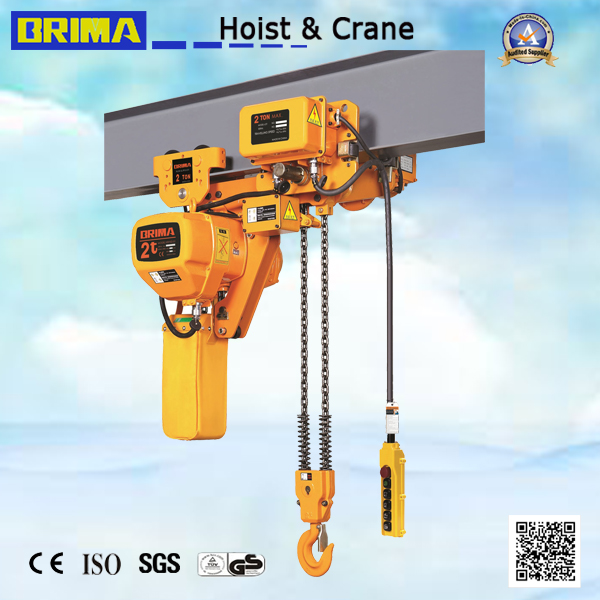
In industrial architecture, headroom refers to the vertical distance from the bottom of the runway beam to the saddle of the lifting hook when fully retracted. In facilities with low ceilings or older infrastructure, standard configurations often fall short. Standard units hang directly below the trolley.
Specialized low-headroom designs solve this structural limitation through an innovative parallel configuration. By mounting the body parallel to the beam and utilizing a specialized chassis, the lifting mechanism is elevated. The chain is routed around offset sheaves. This allows the bottom hook to be raised significantly higher.
For heavy industrial applications operating in confined spaces, investing in engineered solutions is critical. For instance, a 10t Low Headroom Electric Chain Hoist utilizes a specialized trolley frame to maximize vertical lift. These advanced units often feature dual lifting speeds, such as 2.7 and 0.9 meters per minute, paired with robust motorized trolleys traveling at 11 meters per minute. Such specifications ensure that facilities can safely handle massive 10-ton loads without undergoing expensive structural modifications to the building roof.
A mismatch between your facility electrical infrastructure and your motor specifications will lead to immediate operational failure. Beyond this, ignoring the physical environment where the equipment operates can result in rapid corrosion.
Single-phase units run on standard electrical currents found in residential or light-commercial settings. They are suitable for small maintenance workshops and infrequent lifting. Because they rely on starting capacitors and draw higher amperage to generate torque, they heat up quickly. They are not suited for continuous industrial use.
Three-phase power is the undisputed standard for industrial manufacturing. Delivering a continuous and balanced flow of electricity, three-phase motors generate consistent starting torque. They also run significantly cooler. Heavy-duty lifting systems require three-phase power to achieve their rated capacities reliably.
Looking at current material handling trends, there is a clear industry shift toward adopting higher Ingress Protection rated equipment. Driven by stricter safety regulations and rigorous wash-down protocols in modern processing plants, facilities are abandoning basic indoor units. They favor fully sealed systems to prevent costly downtime.
Standard indoor units typically feature an IP44 or IP54 rating. This protects against general dust and light water splashes. However, if your equipment operates outdoors or in a high-dust foundry, an IP65 rating is mandatory. It completely seals the internal gearbox against heavy water jets. Outdoor setups must also be equipped with weather covers and galvanized load chains to prevent rapid oxidation.
Purchasing a unit with an inadequate duty cycle is the leading cause of premature motor failure. Buyers must critically evaluate how often the motor will actuate during a typical shift.
The Hoist Manufacturers Institute classifies equipment based on operational intensity. The classification dictates two primary metrics. First is the maximum allowable on-time from a cold start. Second is the maximum number of motor starts per hour.
H2 Light Duty: Allows 7.5 to 9 minutes of max on-time and 75 starts per hour. It is ideal for infrequent maintenance.
H3 Standard Duty: Provides 15 minutes of max on-time and 150 starts per hour. This is suited for general machine shops and warehousing.
H4 Heavy Duty: Allows 30 minutes of max on-time and 300 starts per hour. This is required for high-volume steel fabrication and foundries.
H5 Severe Duty: Built for continuous automated production lines, offering over 60 minutes of on-time.
Evaluating your daily workflow is non-negotiable. A water treatment facility that only lifts a pump for inspection once a month will be perfectly served by an H2 classification. Conversely, consider a busy steel fabrication plant continuously loading heavy beams onto cutting tables. The operator might jog the pendant rapidly to position the beam precisely. Each tiny jog counts as a motor start. In this harsh environment, an H3 motor would overheat rapidly. Such operations strictly require an H4 heavy-duty motor to handle the immense thermal load.
Material handling is inherently dangerous. Modern lifting equipment must incorporate redundant safety mechanisms to protect operators and secure the load.
A mechanical slip clutch is a vital safety feature. Integrated directly into the gear train, it utilizes friction disks carefully calibrated to a specific torque limit. This is usually 110 to 125 percent of the rated capacity. If an operator mistakenly attempts to lift an overweight load, the clutch will intentionally slip. The motor continues to spin, but the lifting chain stops moving. This fail-safe mechanism prevents the motor from burning out and keeps the chain from snapping under extreme tension.
Limit switches act as vital electro-mechanical boundaries. An upper limit switch automatically severs power to the lifting motor if the hook is raised too high. This prevents the lower block from violently smashing into the housing. Simultaneously, a lower limit switch prevents the chain from completely running out of the sprocket. It ensures that a safe minimum number of chain links remain securely engaged at all times.
Holding a suspended load securely is just as critical as lifting it. Imagine a sudden grid failure during a midnight shift while a massive mold is suspended mid-air. Industrial-grade systems employ redundant braking to ensure absolute load control. Best practices dictate specifying units with an electromagnetic motor brake that engages instantly when power is cut. This is often backed up by a mechanical load brake that physically prevents the load from accelerating downwards. This dual-braking approach ensures absolute stability regardless of power availability.
Selecting the correct overhead lifting solution is a foundational step in improving workplace safety and operational efficiency. By carefully matching load capacity, lifting speed, and duty cycles to your specific workflow, you prevent costly equipment failures. Always take the time to measure your building clearances. Factor in headroom limits and the necessity of specialized trolley configurations for confined spaces.
Never compromise on essential safety features like slip clutches, limit switches, and redundant braking systems. We highly encourage facility managers to assess their unique material handling needs and consult with a lifting expert. Investing in high-quality and properly specified equipment today guarantees long-term success. Ready to upgrade your facility? Explore the full range of Brima Hoist solutions to find the exact specifications and engineered reliability your heavy lifting operations demand.
Only if it is a single-phase unit, usually 115V, designed specifically for light-duty intermittent work. Industrial-grade hoists generally require three-phase power, such as 230V or 460V. This must be hardwired directly into the facility electrical system by a certified electrician to handle the higher torque and duty cycles.
Safety regulations require frequent visual inspections, ranging from daily to monthly. These are conducted by the equipment operator to check for obvious chain wear, hook deformation, and proper limit switch functionality. Additionally, a comprehensive and documented inspection must be performed annually by a certified overhead lifting professional.
A standard unit hangs vertically directly below the trolley. This consumes a significant amount of vertical space. A low headroom design is engineered so the main body sits parallel to, or higher up on, the structural beam. This innovative configuration brings the lifting hook much closer to the ceiling, maximizing your usable lifting height in confined workspaces.
Yes, but standard indoor models will fail quickly if exposed to the elements. For outdoor applications, the equipment must feature a proper Ingress Protection rating, such as IP55 or IP65. It must also include specialized weatherproofing like sealed motor covers, epoxy paint, and stainless steel or zinc-plated load chains to prevent water damage and severe rust.
With proper maintenance and adherence to its rated duty cycle, a high-quality industrial unit can last 10 to 15 years or more. Lifespan heavily depends on the operating environment, frequency of use, and strict compliance with annual inspection and lubrication schedules.
Chain hoists lift loads using a metal linked chain and a sprocket. They provide a true vertical lift, are highly compact, and require less maintenance. Wire rope hoists use a steel cable wrapped around a grooved drum. They are generally preferred for extremely heavy loads over 15 tons, exceptionally high lifting heights, and continuous high-speed operations. However, they are bulkier and can experience lateral hook drift.
